

Silver City Home Seller Fees & Closing Costs Explained

Selling a home in Silver City, Nevada and asking, “What fees will I pay at closing—and what will I actually take home?” That question matters because seller costs are a mix of (1) standard transaction charges, (2) items tied to your property, and (3) terms you negotiate with a buyer. Cassie Craig and Paul Dunham with Craig Team Realty help sellers in Silver City map out realistic numbers early, so the closing statement isn’t a surprise.
Below is a clear, Nevada-specific breakdown of Silver City closing costs seller typically encounters, what changes the total, and how to estimate your net proceeds before you list.
First: What Counts as “Seller Closing Costs” in Silver City?
Seller closing costs are the expenses you may pay to complete the sale and transfer ownership. In most transactions, seller costs include:
- County transfer tax collected when the deed is recorded
- Title and escrow/settlement charges (who pays which parts can vary by written agreement)
- Prorations like property taxes and HOA dues (if applicable)
- Mortgage payoff items if you have an existing loan
- Negotiated items such as repair credits or buyer concessions
Important: the “standard” split you may hear about is often local custom, not a fixed rule. In Nevada, responsibilities can be allocated differently if the parties agree in writing.
The Big One to Know in Silver City: Real Property Transfer Tax
Nevada charges a Real Property Transfer Tax when an interest in real property is transferred and the deed is recorded. For Silver City, Nevada (in Lyon County), the RPTT rate is: $1.95 for each $500 of value (or fraction thereof) for transfers over $100.
How to estimate the RPTT (simple method)
Because the tax is assessed per $500 (or fraction), the final amount can round up depending on the exact value. A quick “ballpark” way to estimate is:
- Approximate RPTT = Sale Price ÷ 1,000 × $3.90
Example (estimate only)
If your home sells for $500,000, a rough estimate would be: $500,000 ÷ 1,000 × $3.90 = $1,950. Your escrow or title team will calculate the official amount based on the recorded value and rounding rules.
Why this matters: even when other fees feel “small,” transfer tax is a predictable line item you can plan for early as part of your Silver City closing costs seller total.
Title & Escrow Costs: What Sellers Commonly See in Nevada
Title and escrow (sometimes called settlement services) help ensure:
- the title to the property is transferred correctly,
- funds are handled safely,
- payoffs and prorations are accounted for, and
- documents are recorded properly.
Owner’s title insurance: often a seller-paid item (but not “automatic”)
In Nevada, local custom often has the seller paying the premium for the owner’s title insurance policy, while the buyer often pays for the lender’s title policy (if the buyer is getting a loan). The key word is “usually”—your purchase agreement and local practice for your specific transaction should be reviewed carefully.
Escrow/settlement fees and related charges
Escrow/settlement charges vary by transaction and provider, and may be split or assigned based on your contract. Common categories include:
- Escrow/settlement service fee
- Document processing and administrative fees
- Notary services (when needed)
- Courier/e-signing/processing charges (when applicable)
The most reliable way to get accurate numbers is to request a preliminary estimate from the title/escrow provider early in your listing timeline.
 Mortgage Payoff: Not a “Fee,” but It Drives Your Net
If you have an existing mortgage, the payoff is typically paid from your sale proceeds at closing. That payoff amount may include:
- your remaining principal balance,
- interest through the payoff date, and
- possible lender processing charges (varies by lender).
Practical tip for Silver City sellers: request a payoff quote early and re-confirm it closer to closing, especially if your closing date changes.
Property Taxes & Other Prorations (What Sellers Should Expect)
Most sales include prorations so each party pays their share for the time they owned the home. Common prorations include:
- Property taxes (prorated based on closing date and what has already been paid)
- HOA dues (if you’re in an HOA)
- Utilities (in some cases, depending on local practice and what’s paid in advance)
Exact proration math depends on the closing date, billing cycles, and what has already been paid. If you have questions about how taxes affect your personal finances, it’s best to consult a qualified tax professional.
HOA Costs in Silver City (If Applicable)
If your property is in an HOA, seller costs can include:
- resale package or document fees,
- transfer fees (if charged by the HOA),
- dues proration, and
- time-sensitive disclosure requirements.
Even if you’ve sold before, HOA processes vary. A simple way to avoid delays is to request HOA documents early so buyers can review them quickly.
Negotiated Costs That Change Seller Totals the Most
Many Silver City seller “closing costs” are not fixed fees at all—they’re negotiation outcomes. Two of the biggest are repair solutions and buyer concessions.
Repairs vs. repair credits
After inspections, a buyer may request repairs, a credit, or a price adjustment. Each approach has trade-offs:
- Doing the repair: can feel cleaner to buyers, but can slow the timeline.
- Offering a credit: can preserve timing and reduce contractor coordination, but reduces your net proceeds.
- Price adjustment: can help the buyer’s financing structure, but changes future appraisal comparisons.
Seller concessions (buyer credits)
A concession is a credit to the buyer at closing. Buyers often ask for credits to help manage their upfront closing costs or to address inspection items. Whether you agree should depend on:
- your home’s condition and documentation,
- how your price compares to competing listings,
- the strength of the buyer’s offer (financing, timeline, contingencies), and
- what helps you reach your real goal (highest net, fastest close, or least hassle).
If you want to stay in control of your bottom line, evaluate concessions using a net proceeds worksheet—not just the purchase price.
Real Estate Service Costs: Keep It Transparent and In Writing
Selling a home typically involves professional services, and the cost structure should be clear, specific, and documented. There is no single “standard” that fits every seller or every transaction. Your best protection is understanding:
- what services are included,
- what the compensation structure is for your listing agreement, and
- how any buyer-side arrangements may be handled in the transaction paperwork.
The main point: nothing should be assumed, and everything should be in writing so you can make informed decisions based on your goals.
A Clear Net Proceeds Formula for Silver City Sellers
Here’s a practical way to estimate what you might take home (before you list or accept an offer):
- Expected sale price (use a realistic range, not just a “best-case” number)
- Minus mortgage payoff (if you have a loan)
- Minus transfer tax (RPTT in Lyon County)
- Minus title/escrow-related costs (including any seller-paid title items)
- Minus prorations (taxes/HOA dues, depending on timing)
- Minus negotiated items (repair credits, concessions, optional warranty, etc.)
Use scenarios to avoid surprises
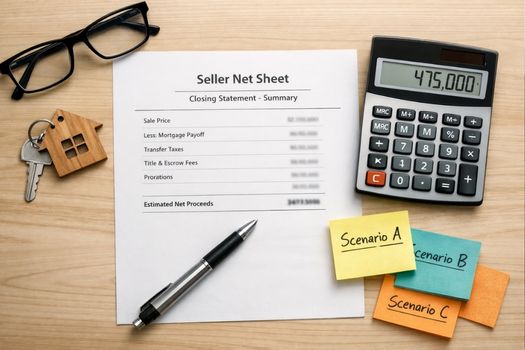
A strong planning method is to run 2–3 scenarios, such as:
- Scenario A: clean offer, no repair requests, no concessions
- Scenario B: modest repair credit
- Scenario C: repair credit + concession
This helps you choose offers based on what you net, not just the headline price.
How to Reduce Closing Cost Stress Before You List
1) Ask for a seller net sheet early
A seller net sheet is an estimate of your costs and likely proceeds. It’s not a final closing statement, but it’s an excellent decision tool.
2) Decide your “inspection strategy” ahead of time
If you already know there are items a buyer will notice, decide whether you want to:
- fix them before listing,
- price accordingly and disclose clearly, or
- plan for a credit if requested.
3) Keep paperwork organized
HOA documents (if applicable), service records, and receipts for improvements reduce confusion and help negotiations stay grounded. For legal questions, consult a qualified Nevada professional.
FAQ: Silver City Closing Costs Seller Questions
Do sellers always pay the transfer tax in Silver City, Nevada?
The RPTT is collected at recording, and how transaction costs are allocated can be addressed in the written agreement. In many transactions it is treated as a seller-side cost, but your contract controls.
Is owner’s title insurance required?
Title insurance is common in Nevada transactions. Local custom often has the seller pay for the owner’s policy, but allocation can be negotiated and should be confirmed in writing with your escrow/title provider and your purchase agreement.
Are seller concessions “real costs”?
Yes. A concession is a credit that reduces your net proceeds. It may not look like a fee, but it directly impacts what you walk away with.
What’s the most accurate way to estimate seller costs?
Combine a seller net sheet with a transfer-tax estimate and real numbers from an escrow/title provider, then run a few negotiation scenarios.
Closing Thought: Sell With Clear Numbers, Not Guesswork
The best Silver City sellers don’t guess their costs—they plan for them. When you understand which fees are predictable (like the Lyon County transfer tax) and which costs depend on negotiation (like credits and repairs), you can price and negotiate with confidence.
If you’re thinking about selling in Silver City, Nevada and want a clear estimate of seller fees, transfer tax, and likely net proceeds, contact Cassie Craig and Paul Dunham with Craig Team Realty at (775) 306-7591.
Helpful related reading: cost to sell, taxes, realtors charge, sell a home, Reno closing costs, Sparks closing costs, Carson City costs, Gardnerville costs, Fallon costs, Verdi costs, Silver Springs costs.
Check out this article next